









Setting Up a Practical Farrier Kit: What to Carry and Why
A farrier’s equipment says a lot about the way they work. While experience and technique remain the most important parts of the trade, having the right equipment within reach can make everyday jobs more organised, efficient and consistent.
For someone just starting out, putting together a farrier kit can be confusing. There are rasps, nippers, knives, hammers, tongs, punches and a long list of other equipment, each designed for a particular task. Experienced professionals may also carry different tools depending on whether they are working from a workshop, travelling between properties or dealing with specialised shoeing requirements.
Rather than trying to buy everything at once, it makes sense to build a kit around the work you actually perform.
Start with the essentials
A practical farrier kit should cover the fundamental stages of hoof preparation and shoe fitting.
This generally means having tools for trimming, shaping, preparing and fitting the shoe, along with equipment for maintaining the hoof and making adjustments when necessary.
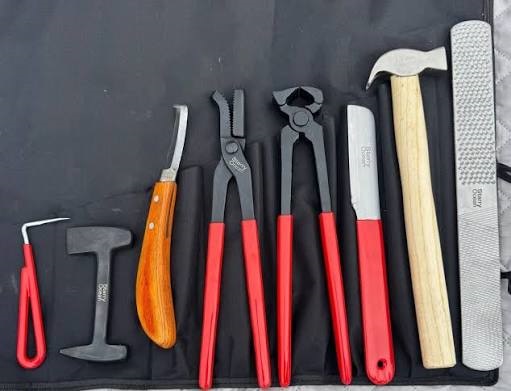
Some of the commonly used items include:
- Hoof nippers
- Hoof knives
- Rasps
- Hammers
- Pritchels and punches
- Clinchers
- Pull-offs
- Tongs
- Measuring and fitting tools
The exact combination will vary between professionals.
A farrier who specialises in a particular area may need additional equipment, while someone beginning their training may only need a basic selection.
The key is to understand what each tool is intended to accomplish before adding it to the kit.
Nippers for trimming work
Hoof nippers are among the most recognisable tools in a farrier’s collection.
They are used to remove excess hoof wall during trimming and preparation. Because the tool is used repeatedly, comfort, balance and cutting performance can all matter.
Different sizes and designs are available, and the right option depends partly on the farrier’s preferences and the horses being handled.
A larger horse with a substantial hoof may require a different approach from a smaller horse. Likewise, a professional who works throughout the day may have stronger preferences regarding handle shape, weight and grip.
Nippers should also be kept in good condition. Dull or damaged cutting edges can make routine work harder and may encourage unnecessary force.
Hoof knives for detailed work
While nippers remove larger amounts of hoof material, a hoof knife provides more controlled trimming.
It can be used for detailed work around the sole, frog and other areas where precision is important.
There are different blade shapes and handle designs available, and farriers often develop preferences based on their working style.
A knife should be sharp enough to perform its intended task while being handled safely. As with any cutting tool, care and proper technique are essential.
For someone developing their first kit, learning how to maintain and safely handle a hoof knife is just as important as choosing the product itself.
Rasps for shaping and finishing
Rasps are another fundamental part of a farrier’s setup.
After trimming, a rasp can be used to shape and smooth the hoof wall. It can also be used when fitting and finishing a shoe.
Rasps are available in different sizes, surfaces and levels of aggressiveness. A professional farrier may use more than one depending on the stage of the job.
Because rasps are consumable tools, they eventually lose their effectiveness. Keeping track of their condition is therefore important.
A rasp that no longer removes material efficiently can slow down work and make the farrier apply more pressure than necessary.
Hammers serve different purposes
A hammer might look like a simple tool, but farrier hammers are designed around specialised work.
Depending on the job, a hammer may be used for driving nails, adjusting shoes or shaping hot metal.
Weight and balance are particularly important. A hammer that feels comfortable in the hand can be easier to control during repeated use.
Farriers who regularly perform hot shoeing or forging may have several hammers suited to different tasks.
Someone setting up a basic kit does not necessarily need every style immediately. It is usually more practical to start with the hammer that suits the work currently being performed and add specialised options as experience grows.
Tongs and hot work
Farriers who modify or forge horseshoes also need appropriate equipment for handling heated metal.
Tongs allow the farrier to grip and manipulate hot shoes safely while working at the forge and anvil.
Different tong designs can provide different types of grip and control.
The right choice depends on the size and shape of the material being handled as well as the type of forging work involved.
Hot work should always be carried out with suitable safety practices, including appropriate protective equipment and adequate ventilation.
Pull-offs and removal tools
Not every farrier job begins with a clean hoof.
Sometimes an existing shoe needs to be removed before the hoof can be inspected, trimmed and prepared.
Pull-offs are designed for this part of the process.
A good removal tool can make it easier to take off an existing shoe while reducing unnecessary strain on the farrier.
As with other tools, technique matters. The equipment should be used carefully rather than relying on excessive force.
Having suitable removal equipment readily available also means the farrier does not need to improvise when an old shoe proves difficult to remove.
Clinchers and finishing equipment
Once a shoe has been fitted and nailed, finishing the job is an important part of the process.
Clinchers and related tools help secure and finish the exposed ends of the nails.
Different designs are available, and the preferred option can depend on the farrier’s technique and the type of shoe being fitted.
A well-organised kit should therefore include not only tools for the initial stages of the job but also equipment for finishing.
This is one reason a farrier’s toolkit can become quite extensive over time.
Specialised tools should come later
There is always another tool that could potentially be added to a farrier’s collection.
However, buying every available product is not necessarily the best approach.
Specialised tools can be extremely useful when a particular job requires them, but they may not justify the cost or storage space if they are rarely used.
Instead, build the kit gradually.
Start with the equipment used on almost every job. Once you understand your regular work patterns, identify the tasks that take extra time or require a specialised solution.
Those are often the areas where an additional tool can provide the most value.
Mobile farriers need to think differently
A farrier working from a permanent workshop has very different storage options from someone travelling between properties.
Mobile farriers need to think about portability, weight and organisation.
The kit needs to contain enough equipment to handle a variety of situations without becoming so large that it is difficult to transport.
Tools that are used frequently should be easy to access, while specialist items can be stored separately.
A well-organised vehicle or mobile workstation can save considerable time over the course of a working week.
It also reduces the likelihood of arriving at a job and discovering that an essential tool has been left behind.
Organisation matters as much as equipment
A large collection of quality tools is not particularly useful if everything is mixed together.
Tool storage should allow the farrier to quickly identify what is needed.
Common approaches include dedicated toolboxes, mobile farrier boxes, magnetic storage and custom-built setups.
The best option depends on how the work is performed.
It is also worth developing a consistent place for commonly used equipment. Once a farrier knows exactly where the nippers, rasp, hammer and knife belong, it becomes much easier to identify when something is missing.
This can be particularly useful for mobile work.
Maintenance should be part of the routine
Farrier equipment is exposed to demanding conditions.
Tools may come into contact with moisture, dirt, metal and repeated impact. Without maintenance, even high-quality equipment can deteriorate.
Cutting tools should be inspected regularly, while metal equipment should be cleaned and stored appropriately.
Rasps should be checked for wear, handles should be inspected for damage and moving parts should be kept in suitable condition.
Maintenance does not need to become a complicated process. A few minutes spent checking equipment regularly can prevent bigger problems later.
Choose quality where it matters most
Not every item in a farrier kit needs to be the most expensive option available.
However, the tools used most frequently are usually worth careful consideration.
For example, a professional farrier may use the same nippers, rasp or hammer hundreds of times. Comfort, durability and performance can therefore have a significant effect on the working experience.
Consumables are different. They need to be replaced regularly, so availability and consistency can be more important than buying the premium option every time.
A sensible purchasing strategy is to identify the tools that directly affect everyday productivity and prioritise quality there.
Building a kit over time
A beginner may look at a professional farrier’s toolbox and wonder how they accumulated so many tools.
The answer is usually simple: it happens gradually.
As experience increases, a farrier encounters different horses, shoe types, hoof conditions and working environments.
Each situation can reveal a new requirement.
Over time, the toolkit becomes a reflection of the work being performed.
There is no need to replicate someone else’s setup immediately. A smaller collection of reliable tools that are well understood can be more useful than a large collection of equipment that rarely gets used.
Finding the right equipment
For anyone building or upgrading a professional setup, specialist suppliers can make the process easier because tools are generally organised according to their intended applications.
A dedicated range of farrier tools can include essential equipment such as nippers, rasps, knives, hammers, pull-offs, clinchers and other products used throughout the shoeing process.
This allows professionals to compare different designs and gradually build a collection around their specific requirements.
The best toolkit is the one that works for you
There is no universal farrier toolkit.
A professional working primarily with performance horses may have different equipment from someone who focuses on general riding horses. A mobile farrier may prioritise portability, while a workshop-based professional may invest in larger forging equipment.
The important thing is to understand the purpose of each tool and select equipment based on actual requirements.
Start with the essentials, maintain them properly and add specialised tools as your work demands them.
A well-designed farrier kit does not need to contain every product available. It simply needs to provide reliable equipment for the jobs that matter most.
When the tools are appropriate, organised and well maintained, they become more than items in a toolbox. They become part of a working system that helps a farrier perform precise, demanding work efficiently and consistently.